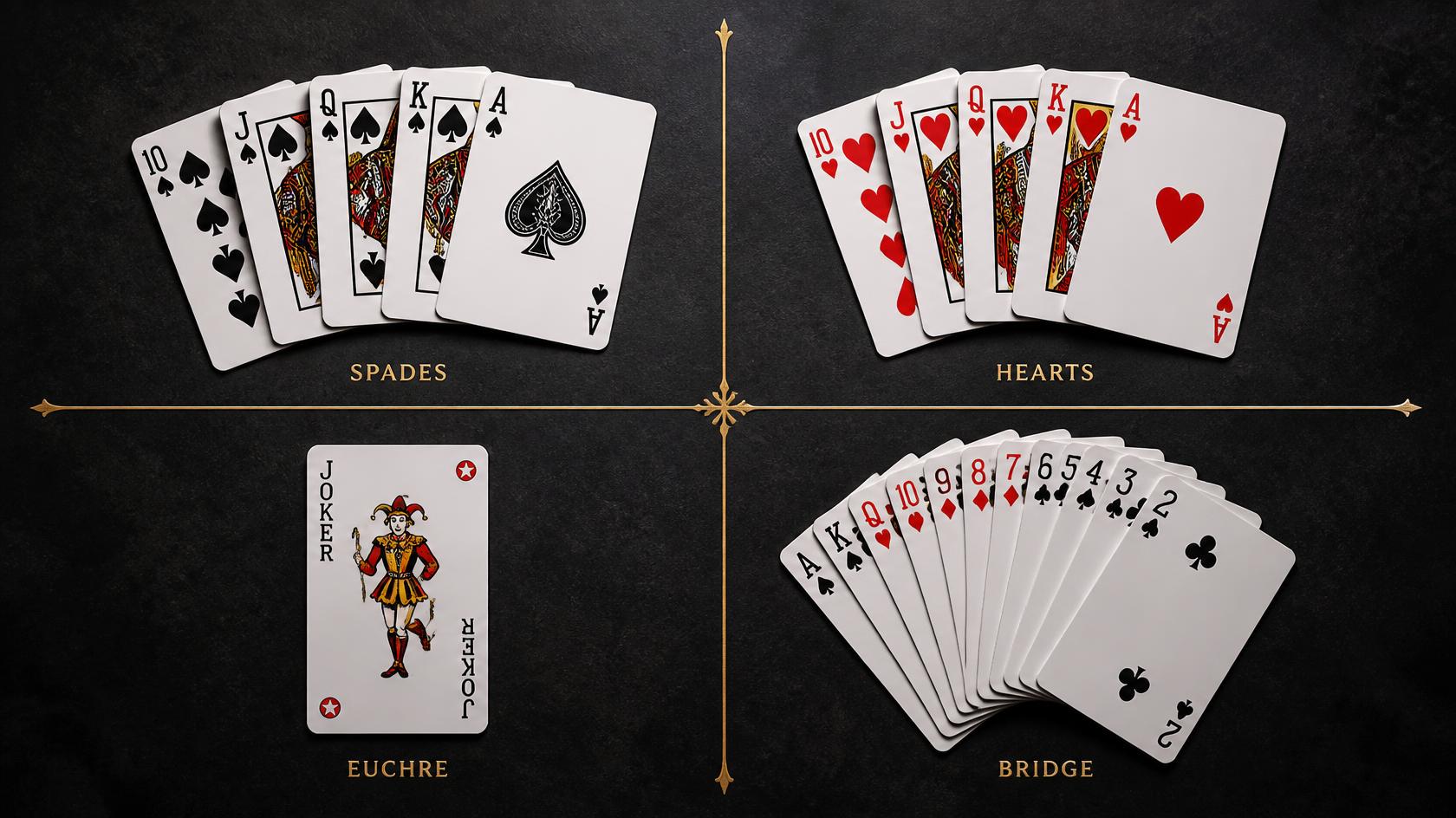
The games, ranked by how well they work with exactly four
Call Bridge
4 players, individual scoring, spades as permanent trump. Play 5 rounds or race to 30 points. Every player gets exactly 13 cards from a standard 52-card deck — no leftover cards, no dummy hand, no team dynamics to manage.
Why it works with 4: Call Bridge was designed specifically for four individual players. The deck divides perfectly, every player bids independently, and every decision is yours alone. No partner to carry you, no partner to blame.
Skill ceiling: High. Bidding accuracy, trump management, defensive play, and overtrick avoidance all matter. The double bonus for calling 6 or higher adds a high-risk, high-reward layer that rewards hand evaluation and courage in equal measure.
Play it free: bridgeplay.online — instant play in your browser with AI opponents or real-time multiplayer. No download, no sign-up.
Spades
4 players in 2 fixed partnerships, spades as permanent trump. Play to 500 points. The partnership dynamic adds a coordination layer — you and your partner bid separately but your scores combine, so reading your partner's play is as important as reading the opponents'.
Why it works with 4: Spades is built around the 2-vs-2 structure. The nil bid — calling zero tricks and trying to duck every one — is unique to Spades and creates some of the most tense moments in any card game.
Difference from Call Bridge: Team-based scoring, a bags penalty for winning too many extra tricks, and the existence of nil bids. Same trump suit, very different game feel. Full comparison here.
Where to play: Multiple free options online, including browser-based and mobile apps.
Hearts
4 players, individual play, no trump suit. The goal is to avoid taking hearts (1 point each) and the Queen of Spades (13 points). Play until someone hits 100 — the player with the lowest score wins.
Why it works with 4: Another game designed for exactly four. The card passing mechanic at the start of each hand — you choose three cards to give to an opponent — creates mind games before the first trick is even played.
Skill ceiling: Moderate-high. “Shooting the moon” — deliberately collecting all penalty cards to dump 26 points on everyone else — is the dramatic swing mechanic. Knowing when to attempt it and when to stop an opponent from pulling it off is what separates good players from great ones.
Where to play: Widely available free online. Bundled with Windows for decades, so most card game sites include it.
Euchre
4 players in 2 partnerships, 24-card deck (9 through Ace), trump suit determined each hand. Play to 10 points. Rounds are fast — only 5 tricks per hand.
Why it works with 4: Euchre is a fast-paced partnership game where the smaller deck means every card matters more. The “going alone” option — one player dismissing their partner and playing solo for bonus points — adds a gambling element.
Regional popularity: Huge in the Midwest USA, Ontario, and parts of Australia. If you grew up in Michigan or Indiana, you probably already know how to play.
Where to play: Several free options available online and on mobile.
Twenty-Nine (29)
4 players in 2 partnerships, 32-card deck, trump suit bid secretly by the declaring team. Play to 6 hands won. The cards are dealt in two phases — four cards first, then the rest after bidding — and the trump suit is revealed only when a player cannot follow suit.
Why it works with 4: The secret trump mechanic makes every trick a guessing game. You might be playing into their trump suit without knowing it, or they might be bluffing strength they do not have.
Regional popularity: Bangladesh and India primarily. Twenty-Nine plays alongside Call Bridge in the same circles — many players are fluent in both.
Where to play: Fewer options than the others. Some mobile apps available; browser-based versions are less common.
Court Piece (Rung)
4 players in 2 partnerships, 52-card deck. The trump suit is determined each hand by the player who receives the first ace during the deal. Play best of 7 hands (called “courts”).
Why it works with 4: Partnership play with a trump mechanic that changes every hand. The ace-pick rule means trump selection is partly random, partly strategic — you want the ace, but you also want it in your strongest suit.
Regional popularity: Pakistan, India, and parts of the Middle East. Part of the same South Asian trick-taking family as Call Bridge. More on the family of games here.
Quick comparison
| Game | Players | Teams? | Trump suit | Scoring |
|---|---|---|---|---|
| Call Bridge | 4 | Individual | Spades (fixed) | First to 30 or 5 rounds |
| Spades | 4 | 2 partnerships | Spades (fixed) | First to 500 |
| Hearts | 4 | Individual | None | Lowest at 100 loses |
| Euchre | 4 | 2 partnerships | Varies each hand | First to 10 |
| Twenty-Nine | 4 | 2 partnerships | Secret bid | First to 6 hands |
| Court Piece | 4 | 2 partnerships | Varies (ace-pick) | Best of 7 |
How to choose between them
Six games, one player count. The right pick depends on what you actually want from a card game session. Here is the quick decision guide.
Want individual competition? Go with Call Bridge or Hearts. Every point is yours, every mistake is yours. No partner to carry you, no partner to blame. Call Bridge adds the bidding layer; Hearts strips it out and replaces it with avoidance play.
Want team play? Spades or Euchre. Both use fixed 2-vs-2 partnerships, but they play very differently. Spades is a longer game with deep partnership coordination. Euchre is fast — five tricks per hand, and games end in minutes rather than hours.
Want fast rounds? Euchre is the clear winner. With only 5 tricks per hand and a 24-card deck, hands resolve quickly. A full game to 10 points can finish in 15 minutes. Compare that to a 500-point Spades match, which can stretch past an hour.
Want deep strategy? Call Bridge or Spades both reward careful play over many hands. Call Bridge's overtrick penalty means you cannot just win everything — you need to win exactly what you bid. Spades' bag penalty creates the same precision pressure, plus you need to read your partner.
Want avoidance play? Hearts is the only game on this list where the goal is to lose tricks, not win them. The Queen of Spades is worth 13 penalty points, and every heart is worth 1. The skill is in dumping dangerous cards on other players without getting stuck with the penalties yourself.
Want hidden information? Twenty-Nine has a secret trump suit that is not revealed until someone cannot follow suit. Every trick before that reveal is a guessing game. Court Piece also has variable trump, but it's determined at deal time rather than hidden during play.
| What you want | Play this | Why |
|---|---|---|
| New to card games | Hearts | Simplest rules — no bidding, no trump suit, just avoid penalty cards |
| Competitive and individual | Call Bridge | Pure individual skill — bidding, trump management, and overtrick penalties |
| Playing with a friend | Spades | Fixed partnerships — coordinate bids and strategies with your partner |
| Short on time | Euchre | Only 5 tricks per hand, games finish in 15 minutes |
| Love bluffing and deception | Twenty-Nine | Secret trump suit creates constant uncertainty and mind games |
| Precision and punishment | Call Bridge | Overbid and you lose double — underbid and you leave points on the table |
| Regional tradition | Court Piece | Part of the South Asian trick-taking family alongside Call Bridge |
What makes a good 4-player card game
It is not a coincidence that the best trick-taking card games all use four players. Four is the number where the math, the competition, and the social dynamics all line up.
The math works perfectly
A standard 52-card deck divides evenly among four players: 13 cards each, nothing left over. No dummy hands, no discards, no leftover pile that changes the information balance. Every card is in someone's hand, and every player has the same number of cards. This is surprisingly rare — with 3 players you get 17 cards each with one left over, and with 5 you get 10 each with two extras. Those leftovers are not just untidy; they introduce hidden information that the game did not design for.
Competition without chaos
Four players is the sweet spot between meaningful competition and individual agency. With two players, every game is a head-to-head duel — no alliances, no positioning, limited drama. With three, someone is always the odd player out and alliances shift constantly. With five or six, individual decisions get diluted and randomness starts to dominate skill.
Four gives you enough opponents to create real competition but few enough that your decisions genuinely matter. Every bid, every card play, every trump decision shifts the outcome.
Trick-taking is a natural fit
The trick-taking mechanic — each player plays one card, highest wins the trick — works best with exactly four. Four cards per trick is enough to create interesting decisions (do you lead strong? do you hold back your trump?) without making tricks so large that the last player always has the advantage. The four-card trick also means 13 tricks per hand, which is long enough for strategy to develop but short enough that each hand feels contained.
Partnerships divide naturally
Four is the only common player count that divides into exactly two equal teams. This is why Spades, Euchre, Twenty-Nine, and Court Piece all use 2-vs-2 partnerships. You cannot do this cleanly with 3 or 5 players. The partnership structure adds a coordination layer — reading your partner, covering their weak suits, setting up their strong ones — that does not exist in individual games but is impossible without even team sizes.
Why these six survived
Hundreds of trick-taking card games have been invented over the centuries. These six survived because each one solves the four-player design problem differently. Call Bridge makes every player independent. Spades adds partnership coordination. Hearts flips the goal from winning tricks to avoiding them. Euchre shrinks the deck for faster play. Twenty-Nine hides the trump suit. Court Piece randomizes trump selection through the deal itself.
They are not six variations of the same game. They are six different answers to the same question: what is the most interesting thing you can do with four players and a deck of cards?
Start with Call Bridge
Free in your browser. No download, no sign-up. Play against AI or invite three friends for real-time multiplayer.
Play Free — No Sign-up Needed ↗Frequently asked questions
What is the best 4 player card game?
It depends on whether you want individual or team play. For individual competition, Call Bridge and Hearts are the strongest options. For partnerships, Spades and Euchre are the most popular. Call Bridge has the highest skill ceiling among individual games due to its bidding, trump management, and overtrick penalty mechanics.
Can you play card games online with 4 players for free?
Yes. Call Bridge, Spades, Hearts, and Euchre are all available to play free online in your browser with no download required. Call Bridge is available at bridgeplay.online with real-time multiplayer and AI opponents.
What card games are similar to Spades?
Call Bridge is the closest relative — same trump suit (spades), same trick-taking core, but individual rather than team-based and with different scoring (double bonus, overtrick penalty). Hearts, Euchre, and Court Piece are also in the trick-taking family but differ more significantly.
What is the difference between individual and partnership card games?
In individual games (Call Bridge, Hearts), every player scores independently. In partnership games (Spades, Euchre, Twenty-Nine), two teams of two share scores. Individual games reward personal skill; partnership games add coordination and communication.
Which 4 player card game has the most strategy?
Call Bridge and Spades both have deep strategic layers. Call Bridge rewards precise bidding, trump conservation, and defensive play. Spades adds partnership coordination. Hearts has strong avoidance strategy but less bidding depth. Euchre is faster and lighter.